

Walk past the front office of almost any middle or secondary school in the first two weeks of September and you’ll see it: a small, steady line of students at the window, each one saying some version of the same sentence. “I forgot my locker combo.” “I think I got the wrong locker.” “Can someone look mine up?”
It’s not a crisis. It’s not even unusual. It’s just Tuesday. And Wednesday. And every day until the school settles into its routine — except this particular routine never really goes away, because students keep forgetting combos straight through June.

The part nobody accounts for
Back-to-school locker assignment is the visible cost. Multiple staff members, sometimes for days, manually matching student rosters to a locker inventory, writing down combinations, double-checking that nobody got assigned a locker that’s already occupied or broken. That part shows up on everyone’s radar because it’s concentrated and obvious.
The part that doesn’t show up on anyone’s radar, because it’s spread out in small pieces across the entire school year, is the daily interruption cost. Every “I forgot my combo” is a context switch — the secretary stops what she’s doing, finds the right spreadsheet tab, looks up the student, relays the combination, and gets back to whatever she was doing before. Multiply that by however many students forget on a given day, multiply that by however many school days are in a year, and the number gets large fast. Not dramatic. Just constant.
The real problem underneath both
Both of these — the September crunch and the daily trickle — trace back to the same root cause: a spreadsheet is the single source of truth for something hundreds of people need to access. Spreadsheets don’t update themselves when a student switches lockers mid-year. They don’t sync if two staff members edit different copies. They go stale, they go out of sync, and when a dispute comes up — “this isn’t my locker” — somebody has to manually reconcile who’s right.
It works, in the sense that schools have been doing it this way for years. But “it works” and “it’s not costing you anything” are different claims, and the second one isn’t true.
What changes when students can serve themselves
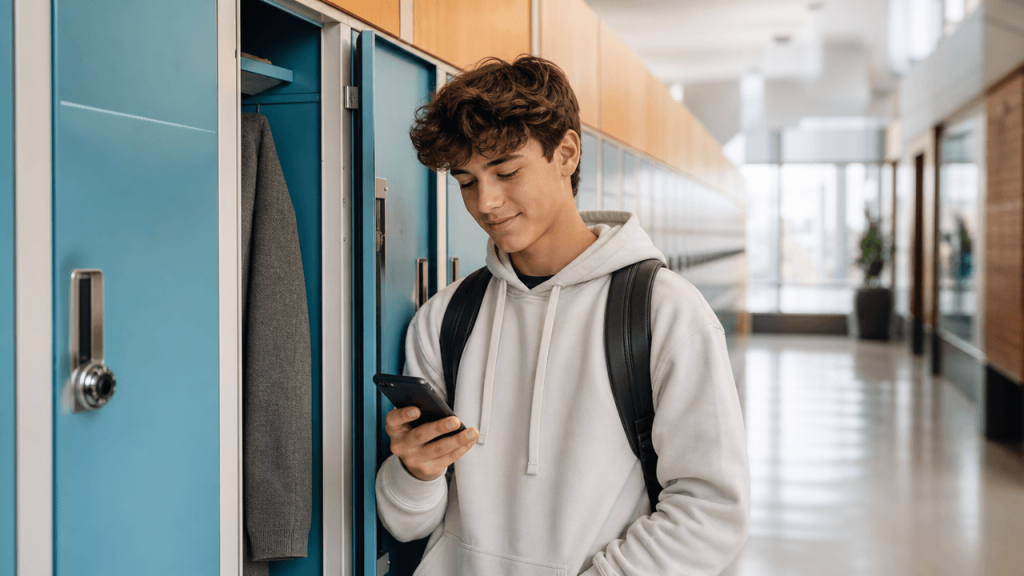
The schools that have moved away from this model report something consistent: the locker problem stops being a staff problem almost entirely. Students log in, see what’s available, and pick their own locker — no waiting on an office appointment, no staff member manually assigning anyone. If they forget the combination later, they log in again and retrieve it themselves, at 11pm on a Sunday if that’s when they happen to think of it.
Kristina Anderson, Head Secretary at Fraser Heights Secondary in Surrey, BC, put it plainly: when students forget their combination, the office now just tells them to log in and look it up themselves — and because the system is always current, any staff member at the front desk can pull up accurate locker information instantly, without digging through an outdated spreadsheet.
That’s the shift. Not “locker management gets a nicer interface.” The actual office workload disappears, because the people who need the information can get it without involving staff at all.
A second-order benefit worth naming
There’s also a quieter advantage that shows up in schools with linguistically diverse student populations — and in cities like Vancouver, Toronto, or Surrey, that’s most schools. A locker system that only works in English creates a small but real barrier for students and families who are more comfortable in another language. A self-service system available in ten or more languages — French, Spanish, Mandarin, Vietnamese, Punjabi, Arabic, and others — means every student can navigate the process independently, without needing a translator or a parent to intervene. It’s not a headline feature, but for the families it actually helps, it matters.
What this is really about
The locker line at the office window isn’t a discipline problem or a student-responsibility problem. It’s an infrastructure problem — built on a tool that was never designed for hundreds of people to use at once, and which puts every single lookup through a staff member as a bottleneck.
Fix the infrastructure, and the daily interruptions and the September crunch both go away at the same time, because they were always the same problem wearing two different costumes.
Locker Administration OnLine replaces the spreadsheet-and-staff-lookup model with self-service student access — locker selection, combination retrieval, and fee collection, all without staff involvement. Read the full story from Fraser Heights Secondary, or see how it works at lockerassignment.com.